
Key information
We were recently ranked 1st in the UK for Electrical and Electronic Engineering in the Daily Mail University Guide 2026, reflecting the exceptional quality of our teaching, research, and industry engagement in the field.
- UCAS code
- H605
- Level
- Undergraduate
- Delivery type
- Full Time
- Degree qualification
- MEng
- Mode of delivery
- On-Campus
- Duration
- 4-5 years
- Location
- Edinburgh
- Start date
- September
Overview of Programme
MEng (hons) Electrical and Electronic Engineering provides you with a broad-based education in the subject, and develops your critical understanding of the core theories, principles and concepts relating to the use of engineering and computer technology. You’ll integrate engineering principles with the knowledge and understanding of mathematics, science, and management to adopt a holistic approach to solve current and emerging electrical engineering problems.
During the first three years students study topics from low current electronics to high power systems. During the 4th and 5th years, your technical studies are advanced to a Masters level and the syllabus is greatly extended in the area of engineering management. You will also have the opportunity to complete a six-month industry placement during your final two years, and complete advanced courses in Electrical Engineering, Computer Science, and Mechanical Engineering.
The undergraduate programme will make you aware of the range of functions a qualified engineer can fulfil, whilst exploring industry-specific design techniques and software packages. You’ll analyse economic and commercial aspects of business, and develop the skills to create solutions to the current and emerging general and specialist problems in electrical engineering.
During your studies, you will apply our ‘learning by doing’ philosophy by practically developing your skills beyond traditional academic content. You’ll work on both individual and group projects from third year onwards, gaining valuable hands-on experience. The projects challenge you to solve a 'real life' problem – such as the project in which our students helped design an electronic egg to monitor penguin incubation. You will be taught how to use industry-standard equipment and facilities, and will be supported and encouraged by staff to use the equipment to further your studies, innovate creative engineering solutions in your personal time, and apply your knowledge to relevant societies and extracurricular team competitions, including CanSat, and Formula Student.
Upon completion of the programme, you will develop the theoretical and practical knowledge and skills required by industry, making you highly employable and sought after by electrical engineering companies world-wide.
Your student experience
Our Expertise
Your learning will be informed by the expertise of our research-active robotics and electrical and electronic engineers and academics.
96% of Heriot-Watt University’s engineering research was classed as world-leading in the REF 2021 review, which ranked us 1st in Scotland and 3rd in the UK for engineering research through a joint submission with the University of Edinburgh.
We were recently ranked 1st in the UK for Electrical and Electronic Engineering in the Daily Mail University Guide 2026. Heriot-Watt University also achieved 3rd in Scotland for Electrical and Electronic Engineering in the Guardian University Guide 2026, reflecting the exceptional quality of our teaching, research, and industry engagement in the field.
Our MEng Electrical and Electronic Engineering draws upon the world class research carried out by Heriot-Watt as part of the Research Institute of Signals, Sensors and Systems (ISSS). The ISSS is one of five Research Institutes forming the research infrastructure of the School of Engineering & Physical Sciences (EPS). The ISSS has expertise in the fields of signal and image processing, novel manufacturing technologies, microsystems, microwave engineering, mobile communications systems, and autonomous systems.
You will also benefit from the work completed by the on-campus National Robotarium. The multimillion-pound UK innovation hub for robotics and autonomous systems has been built in collaboration with the University of Edinburgh and delivers leading research and support for business creation and growth. The presence of the National Robotarium provides you with the opportunity to gain knowledge and skills at the forefront of robotics and AI.
The research relevance of this undergraduate programme ensures your studies remain cutting-edge and industry focused.
Go Global
Go Global is our student mobility programme, allowing you to seamlessly transfer your studies to one of our global campuses, or to a partner university. Live and learn in a new country, experience different cultures and build a global perspective, while continuing your degree without interruption.
Inter-Campus Transfer: Dubai
Inter-Campus Transfer: Malaysia
European Exchange
Worldwide Exchange
Course content
September Intake - Edinburgh
Circuit Theory, Digital Design, Mathematics, Computer Programming and Electronic Design form the core subjects. In addition, students choose an elective option from a list that includes Mechanics and Physics.
Mandatory September
- Mechanics, Fields and Forces
- Introduction to Electrical and Electronic Engineering
- Praxis Electronic Design
- Mathematics for Engineers and Scientists 1
Mandatory January
- Waves and Matter
- Praxis Programming
- Introduction to Mechanical Engineering
- Mathematics for Engineers and Scientists 2
Disclaimer
The courses mentioned above may change between now and the time that you study. For more information, please view our Terms and Conditions.
Programme Video
How to watch this YouTube video
We couldn't detect your cookie choices so can't show this video here. You can watch on YouTube below.
Student testimonials
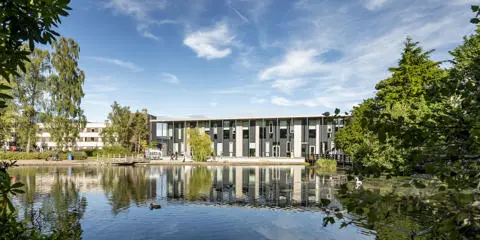
See moreI decided to study at Heriot-Watt University because I was impressed by the facilities they had, particularly the GRID building. A typical day in my programme involved theoretical and practical working, including lectures and tutorials, as well as solo and group projects. The MEng programme in Electrical and Electronic Engineering also allowed for a six-month industry placement, which made this course particularly valuable in preparing for a career in industry.

Fees and funding
| Status | Fee |
|---|---|
| Scotland | Paid by SAAS |
| England / Wales / N Ireland / Rep of Ireland | £10,050 |
| International | £26,840 |
- Status: Your residency status is usually defined as the country where you have been ordinarily resident for the three years before the start of your course.
- International: 'International' includes applicants from European Union countries who do not hold Pre-Settled or Settled status in UK. (This does not include students from the Republic of Ireland - see above).
Scholarships and bursaries
Bursaries for students from England, Northern Ireland or Wales
In addition to government loans and grants towards the costs of fees and living costs, we are offering generous financial support to attract and support eligible undergraduate students from England, Northern Ireland or Wales:
- Heriot-Watt University Bursary (up to £3,100 per year)
Entry requirements
If joining us in September 2027, please see the entry requirements below. Heriot-Watt offers different entry requirements, depending on your background.
Standard entry requirements
Standard entry requirements
- Highers AAAB (over two sittings). Must include Maths and one of Physics, Technological Studies or Engineering Science, with one required subject achieved at A.
- A-Levels BBB. Must include Maths and either Physics or Electronics, with required subjects at BB.
- International Baccalaureate 30 points. Must include Physics and Maths, both at Higher Level 5.
- BTEC Extended Diploma DDM. Must be relevant science subject including sufficient Physics and Maths.
- HNC A in graded unit. Must be relevant science subject including sufficient Physics and Maths. All HNCs must include Engineering Maths 1 and one of Engineering Maths 2 or 3.
- HND BB in graded unit. Must be relevant science subject including sufficient Physics and Maths. All HNDs must include Engineering Maths 1 and one of Engineering Maths 2 or 3.
Please check that you meet our University-wide National 5/GCSE (or equivalent) English and Maths requirements.
Minimum entry requirements *
- Highers BBBC (over two sittings). Must include Maths at B and further B in one of Physics, Technological Studies or Engineering Science
- A-Levels BCC. Must include Maths and either Physics or Electronics, with one required subject at B.
- International Baccalaureate 28 points. Must include Physics and Maths, both at Higher Level 5.
- BTEC Extended Diploma DMM. Must be relevant science subject including sufficient Physics and Maths.
- HNC A in graded unit. Must be relevant science subject including sufficient Physics and Maths. Graded Unit at B will be considered if additional maths has been achieved. All HNCs must include Engineering Maths 1 and one of Engineering Maths 2 or 3.
- HND BB in graded unit. Must be relevant science subject including sufficient Physics and Maths. All HNDs must include Engineering Maths 1 and one of Engineering Maths 2 or 3.
* Minimum: under our Fair Access Policy, we will relax our standard entry requirements for some Scottish and Rest of UK status students depending on their circumstances. Our minimum requirements will apply if you:
- live in an area within the Scottish Index of Multiple Deprivation lowest 20% (SIMD20) or POLAR4 Quintile 1 regions (RUK)
- or are care experienced.
We can also make exceptions for some Scottish students with grades above minimum but below standard. Read more about our Minimum and standard entry requirements.
Why Heriot-Watt
We have been producing career-ready graduates since 1821. With our roots as the world’s first Mechanics Institute, Heriot-Watt is a pioneering university with a global reach.
At Heriot-Watt, learning goes beyond the lecture theatre. We tackle real world challenges through extraordinary research – from climate change to protecting our oceans, to advancing life-saving medical breakthroughs and shaping the next generation of AI. We are also committed to developing forward-thinking design and sustainable business practices that impact industries worldwide. On our campuses you’ll find some of the world’s most advanced facilities, while our strong industry links set you up for career success. This is why almost 90% of our graduates are in employment or further education (Graduate Outcomes Survey 2024).
Employability
Work and study
Salary
Potential career paths
- Engineering professionals
Student life
Explore facilities, and chat to staff and students


Discover Uni course data
Discover Uni provides data on each university's degree courses across a range of measures including student satisfaction, graduate jobs and salaries.